
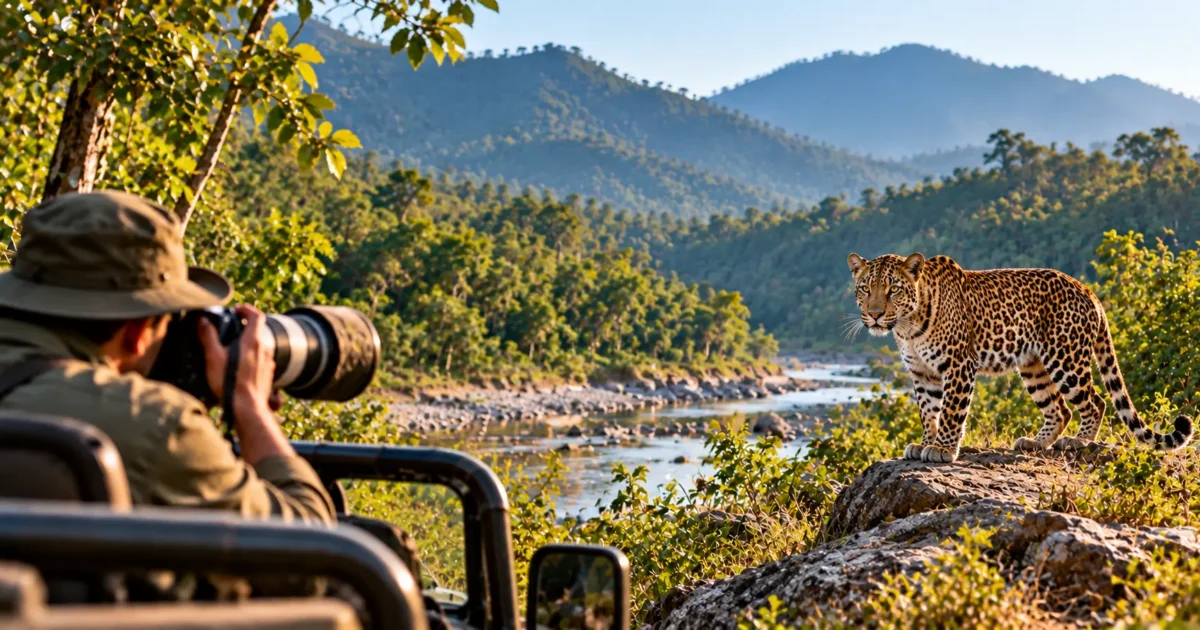
A Rajaji leopard photography tour is built around one of the hardest and most rewarding subjects in Indian wildlife photography. The Indian leopard is shy, nocturnal by habit and a master of camouflage. When it finally steps onto a ridge in soft morning light, the wait is forgotten in seconds. Rajaji National Park, spread across the Shivalik foothills near Haridwar, Rishikesh and Dehradun, is one of the better reserves in North India for that moment.
This guide explains how a leopard-focused photography trip works: which zones to choose, how leopards behave, the best light, camera settings, gear, ethics and booking. We are an independent safari booking service based in Haridwar, so we will also be honest about the limits. Leopards are never guaranteed, but good planning improves your odds a great deal.
Why Rajaji Is Good for Leopard Photography
Rajaji covers about 820 sq km and became a Tiger Reserve in 2015. Based on the figures we follow, it holds 250+ leopards alongside 50+ tigers, 350 to 500 Asian elephants and 315+ bird species. Several things help photographers:
- A healthy leopard population. Rocky ridges, stream beds and dense cover suit the species well.
- Fewer vehicles. Rajaji is far less crowded than many reserves, so a sighting is less likely to turn into a traffic jam.
- Varied backdrops. Sal forest, grassland, boulders and tree canopies give you different looks from one drive to the next.
- Easy access. Motichur is about 20 km from Rishikesh, and the park is 15 km from Haridwar and roughly 250 km from Delhi.
The trade-off is dense forest. Rajaji is not open savannah, so frames are earned with patience and a good guide.
What Is a Rajaji Leopard Photography Tour?
A Rajaji leopard photography tour is a jeep safari plan designed around leopard behaviour and good light instead of general sightseeing. It is not a separate government product. It is a customised combination of standard safari slots, a certified guide and photographer-friendly logistics.
In practice, a Rajaji leopard photography tour usually includes:
- Dawn and late-afternoon slots, when leopards are active and the light is soft
- Two or three photographers per jeep, instead of six, so everyone has a window and room to move
- Multiple drives in the same zones, because the second or third visit often succeeds where the first did not
- A guide who positions the jeep, reads alarm calls, and chooses angles with clean backgrounds
- Help with permits, ID checks and booking
If you want a broader plan that covers general leopard sightseeing as well, see our Rajaji leopard safari package guide. For all subjects, read the wildlife photography safari guide.
Understand the Leopard Before You Raise the Camera
Better photographs start with better fieldcraft. These behaviours shape every decision on a leopard shoot.
Crepuscular and nocturnal. Leopards are most active at dawn, dusk and night. At midday they rest in shade, which is why mid-morning drives are rarely productive.
Ridge and corridor walkers. They prefer rocky outcrops, dry stream beds and forest edges. Your guide will focus on these natural movement paths.
Tree climbers. Leopards rest on branches and drag prey into trees. Scan the canopy, not just the road.
Camouflage experts. The rosette pattern vanishes in dappled light. Many sightings start with your guide noticing an ear flick, a tail tip or a pair of eyes.
Alarm-call followers. Langurs, spotted deer and peafowl call loudly when a leopard is near. When your guide says to stop and wait, listen.
Short-appearance subjects. A leopard may cross a road in seconds. Keep your camera ready, focus mode set and shutter speed high before the animal appears.
Best Zones for Leopard Photography
Motichur Zone: first choice
Motichur is the closest zone to Rishikesh and is known for leopard sightings and over 200 recorded bird species. The forest mixes dense cover with open grassland patches, which gives leopards both shelter and hunting ground. If you book only one zone, this is it. Details are on the Motichur Safari Zone page.
Ranipur Zone: quiet and rocky
Ranipur is the least crowded zone, with rocky Shivalik ridges, leopards and the Himalayan Goral. Rocky terrain gives you textured backgrounds and natural vantage points. Fewer jeeps means a calmer forest. See the Ranipur Safari Zone page.
Chilla Zone: the add-on
Chilla is best known for tigers and elephants, but leopards live here too. Adding a Chilla morning to your plan gives you elephant herds and Ganga canal landscapes between leopard drives. Read the Chilla Safari Zone guide.
Mohand Range: the Dehradun-side option
The Mohand Range is a quieter stretch of chir pine and sal forest close to Dehradun. Leopard sightings are possible but less frequent, so treat it as a bonus. See the Mohand Range safari page.
You can compare all five in the Safari Zones overview.
Best Time for a Rajaji Leopard Photography Tour
Rajaji is open from 15 November to 15 June each year. Right now the park is closed, and the 2026-27 season opens on 15 November 2026.
Winter (15 November to February). Cool, clear air and comfortable temperatures (about 5°C to 22°C). Leopards are active in the cooler hours, and mornings can offer misty, atmospheric light. Fog can slow your shutter speed, so plan for it.
Spring (March to April). The forest turns green, and temperatures stay manageable (about 18°C to 32°C). Slots are easier to get.
Pre-monsoon (May to 15 June). It is hot (about 28°C to 42°C), but animals gather near the few remaining waterholes, so sighting chances improve across species. Crowds are very low.
Time of day. For a Rajaji leopard photography tour, the first slot (6:00 to 9:30 AM) and the last slot (3:00 to 6:30 PM) are the ones that matter. Midday heat keeps leopards resting in shade, so skip those hours. Our best time to visit guide gives the month-by-month view.
Camera Gear for Leopard Photography
Lens. A 100-400mm or 150-600mm zoom is the practical choice. Leopards are often 20 to 60 metres away, so a 70-300mm may leave you short. A 500mm prime is superb but heavy in a moving jeep.
Body. Any DSLR or mirrorless camera with fast, reliable continuous autofocus and a good burst rate. Subject detection and eye autofocus help a lot in dappled light.
Support. Tripods are impractical in a jeep. Use a bean bag on the window frame or a clamp-style monopod.
Extras.
- Two or three memory cards and spare batteries
- Lens hood and cleaning cloth, since forest tracks are dusty
- A dust cover or plastic bag for the camera between drives
- Binoculars to find subjects before you raise the lens
Permits. DSLR and video cameras need a permit at ₹200 for Indian visitors and ₹500 for foreign visitors, paid at the gate before entry. Mobile phone cameras are free. Do not carry a drone, as drones are not permitted in protected forest areas.
Camera Settings for Leopards
Use these as starting points and adjust to the light.
| Situation | Mode | Shutter speed | ISO | Notes |
|---|---|---|---|---|
| Leopard resting or sitting | Aperture priority or manual | 1/800 | Auto, capped at 3200 | Focus on the eye |
| Leopard walking | Manual | 1/1000 to 1/1600 | Auto, up to 6400 | Continuous AF, burst mode |
| Leopard running or leaping | Shutter priority or manual | 1/2000 to 1/3200 | Auto, up to 6400 | High-speed burst |
| Dawn or dusk | Manual | 1/500 minimum | 3200 to 6400 | Accept grain over blur |
| Dappled light on the cat | Spot or partial metering | 1/1000 | Auto | Expose for the face, not the bright background |
A few habits that save frames:
- Shoot RAW to recover highlights and shadows later.
- Use back-button focus so you can track movement without refocusing.
- Pre-set your camera before a sighting. You will not have time to adjust.
- Keep the engine off once you stop. Vibration softens images.
- Never use flash. It startles the animal and can affect its eyes.
Composition and Fieldcraft
- Aim for the eye. A sharp eye can rescue an otherwise average frame.
- Shoot at eye level where the terrain allows. Look for a ridge or bank that lets the jeep sit level with the cat.
- Use the habitat. A leopard on a rock with sal forest behind it tells a better story than a tight crop.
- Watch the background. Ask your guide to move the jeep a few metres to avoid a branch growing out of the subject’s head.
- Anticipate. If a leopard walks along a ridge, prefocus on a point ahead of it and wait.
- Catch tree portraits. A leopard resting on a branch, framed by leaves, is one of the classic frames.
- Do not chase. Let the leopard decide its path. Moving the jeep suddenly ends more sightings than it creates.
Sample 3-Day Rajaji Leopard Photography Tour Itinerary
Each safari is booked as its own slot, so you can adjust this plan.
Day 1. Arrive in Haridwar or Rishikesh. Evening safari (3:00 to 6:30 PM) in Motichur to scout the zone and warm up.
Day 2. Morning safari (6:00 to 9:30 AM) in Ranipur. Rest and edit during midday. Evening safari in Motichur again, to revisit the same corridors in different light.
Day 3. Morning safari in Chilla for elephants and a possible tiger, or a second Motichur morning if leopards are your only target. Depart after lunch.
That gives you four or five drives in two or three days. If you can only spare one night, take the evening Motichur slot followed by a morning Ranipur or Motichur slot. This itinerary is the backbone of most Rajaji leopard photography tour bookings.
Cost of a Leopard Photography Trip
The main cost is the jeep, shared among a small group.
| Item | Indian visitor | Foreign visitor |
|---|---|---|
| Park entry (per person) | ₹150 | ₹600 |
| Jeep safari (per vehicle, max 6) | ₹2,500 | ₹4,500 |
| DSLR / video camera permit | ₹200 | ₹500 |
| Mobile phone camera | Free | Free |
| Children (5 to 12 years) | 50% off entry | 50% off entry |
Because the jeep fee is per vehicle, two or three photographers pay a larger share each, but they gain space and comfort. Add transport, stay and food. Check the ticket price page for the latest fees, and read the Jeep Safari guide for how the vehicle works.
How to Book a Rajaji Leopard Photography Tour
- Choose your dates. Winter weekends fill first, so book 2 to 3 weeks ahead.
- Select zones and slots. Motichur and Ranipur for leopards, with Chilla as an optional add-on.
- Decide on group size. Two or three photographers per jeep is ideal.
- Submit ID details. Indian visitors need a valid government photo ID (Aadhaar, Voter ID, driving licence or PAN) for every guest, and foreign visitors need a passport. Carry the originals, as IDs are re-checked at the gate.
- Confirm on WhatsApp. We check availability, confirm slots and share your final plan.
Start on the safari booking page. You can also read our guide on how to book a Rajaji safari online, and if you need accommodation, see where to stay.
Ethics and Safari Rules
A great photograph is never worth stressing an animal.
- Stay inside the jeep except at designated stops.
- Never use bait, calls or playback to attract a leopard.
- Keep your distance, keep your voice low and keep the engine off during a sighting.
- Do not share live location of a sighting on social media, since crowds can disturb the animal.
- Follow your guide’s instructions at all times.
- Do not litter or leave single-use plastic behind.
Relaxed leopards stay longer and behave naturally, so ethical behaviour improves your images too.
Frequently Asked Questions
Can you guarantee a leopard sighting on a Rajaji leopard photography tour?
No honest operator can. Leopards are elusive, and sightings depend on weather, season and luck. Multiple drives in Motichur and Ranipur with an experienced guide raise your chances significantly.
Which is the best zone for leopard photography in Rajaji?
Motichur Zone is our first recommendation, followed by Ranipur. Chilla and Mohand are useful add-ons.
How many safaris should I book?
Four to five drives over two or three days is a sensible target. A single safari is too short for a leopard-focused plan.
What lens do I need?
A 100-400mm or 150-600mm lens covers most situations. Shorter lenses work for habitat shots but not for distant cats.
Do I need a camera permit?
DSLR and video cameras need a permit: ₹200 for Indian visitors and ₹500 for foreign visitors, paid at the gate. Mobile phones are free. More answers are on our FAQ page.
Final Thoughts
A Rajaji leopard photography tour rewards patience, preparation and respect for the animal. Choose Motichur and Ranipur, book the first and last slots of the day, carry a long lens and stay quiet. You may spend hours waiting for a few seconds of action, and that is what makes the frame feel earned.
If you also want elephants and birds on the same trip, read our wildlife photography safari guide, and if tigers are on your list, see the Rajaji tiger safari guide.
Ready to plan? Book your Rajaji safari or WhatsApp us for dates and availability.